Showing posts with label Clinton Krager. Show all posts

Wednesday, May 30, 2012

Field Camp 2012

Hey folks! I'm back from the world of a non-working power cord and a dead battery :) Also, my life has finally stabilized for a few months.

Last week I participated in FLCC's week-long course called Conservation Field Camp. This is a class that all students going through the Natural Resources Conservation, Conservation Law, and I think Fisheries Technology programs must participate it. I was a student in it last summer, and this spring I applied to be a student technician this time around. I was hired to be a "wildlife tech" under conservation professor John Van Niel (wildlife expert), and biology professor (cell bio expert) Clinton Krager. My friend/future roommate, Mady, was also a wildlife tech.

The four of us were in charge of exposing students to camera trapping, small mammal trapping, bat mist-netting, track identification, using track boards, and GPS/telemetry.

There is SO much I could write about, and I have a ton of pictures...but I don't have the time to write about it all. We caught flying squirrels, red squirrels, chipmunks, deer mice, and jumping mice in the traps, and I have some awesome pics of critters in the hand. And I hope that John at Backyard Beasts posts some of the camera trap pics we caught. Some AMAZING first "traps" for me personally, but he has all the pictures :)

What I'M going to write about is the bat mist-netting. This was a first time experience for me personally, so I was super excited to see what we caught. Because bats are nocturnal, we couldn't set the nets 'til about 8:30-9pm. The students were technically done with class at 9:30, and the days were long...so by the time bats came out, many were ready to head to bed.

So, on Monday night: John and I set the nets while Clinton gave a brief lecture on what bats live in our area, some natural history, winter adaptations, and some information on bat-related diseases.

Before I continue, I must add that John and Clinton both received intensive training in mist-netting and handling bats. It's not something that anyone can just do for fun. They also both received the full round of rabies vaccinations as a precaution, and then on top of that, they wear leather gloves covered by vinyl gloves that get swapped out between each bat.

Ok, so the net was set...and we walked away from it for 15 minutes. Checked it: nothing. Waited 15 minutes, checked it: nothing...and onwards for about 45 minutes. Student numbers were dwindling, all four of us were losing patience and interest...and so we called it a night, bat-less.

Tuesday night, we has a new group of students, and so Clinton went through his schpeel again, while John and I set nets up. I think Mady was napping... :)

We waited a few sets of 15 minutes...and then:

A BAT!
I'm unsure of species...the 4 of us meant to look at the pics I took and try to ID this little guy, but that didn't happen. The guesses were a big brown bat (Eptesicus fuscus) based on Clinton and John's previous experience handling bats. This little guy was pretty vicious, which you could expect from any wild animal, but some have more attitude than others.

Student Melissa Miller and John checking out which side of the net the bat is on. Sometimes it's hard to tell because they get themselves so tangled!

Check out the dentition on this guy! In our Intro to Fish and Wildlife class that John teaches us to ID skulls from black bear through the canids, rodents, lagomorphs, and the bats, amongst many others. The chiropteras have this gap in their jaw, which you can see here between their canines. It's cool to finally see in "live" after studying just skulls for so long.

John assisting Clinton remove the bat from the net. Sometimes, as bird banders can attest, you just can't get the bird/bat out of the net. As any hands-on studying requires some amount of stress, we the researchers should have the animals welfar first in mind. Clinton probably could have gotten that bat out eventually, but not without loads of stress on this little guy. So John took a small pocket knife and carefully snipped the constricting lines.

FREEDOM! I love this picture :)

They're surprisingly furry!
I kind of wanted to touch it, but I couldn't because I'm not vaccinated for rabies.

The rest of the week yielded no bats. For those of us who were there Tuesday night, we got to witness a very cool thing. Even though bats are a common critter in NY, we don't often get to see them up close. We didn't have a high success rate of captures, but I hope that John and Clinton know that it was totally worth the time and effort to set those nets every night.


PS: I'm in ALASKA! I will be writing an entry soon on my first day here before I started work!


Friday, May 4, 2012

...The Continuing Story of the Bobcat Dissection...

If you're just joining my blog, head over to Backyard Beasts  written by John Van Niel to get some background information on this bobcat dissection that I am writing about. John has been my advisor for the past 2 years at FLCC, instructor, and definitely mentor. He's the one who helped push me into writing "publicly", so when he suggested we tag-team write a blog post, of course I jumped at it! (...also I wanted hits from his blog ;) ... ) I must mention again that this was a Wildlife Society club event that all students were invited to. I think at the most we had 35 students in the classroom, and several faculty/staff as well. It was an extremely rewarding for me, as I've spent a lot of my time planning and advertising events like this. So when people show up- it makes me feel like my time spent was worth it.

Photo credit: Melissa Miller

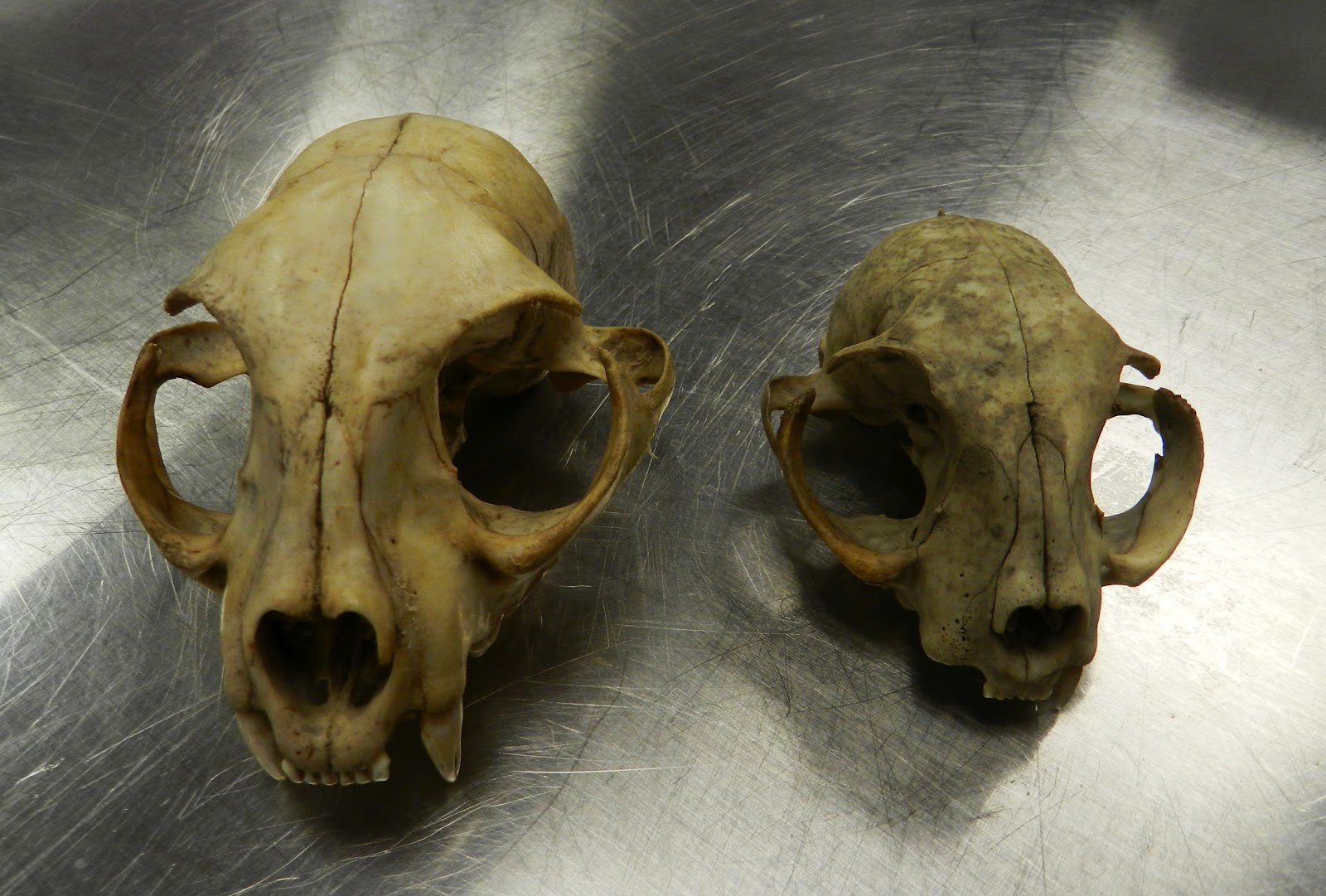
After we all carefully checked out the bobcat, who was in excellent condition besides being deceased, and despite having been killed by a vehicle, John spoke to all of us about some external anatomy. Again, check out John's entry for more of that. I just wanted to mention before getting into the dissection, that we talked about the skull. John brought with him a skull of a domestic cat for some perspective.

Bobcat and bobcat skull

Bobcat on left, domestic cat on right

Side view of bobcat and domestic cat

John then gloved up and made the first cut.


***WARNING***

The following pictures are extremely graphic.

If you are uncomfortable with viewing blood, and a dead animal please do not continue. I would like to mention, even though John did, that this bobcat was hit by a car in the Finger Lakes, collected by a wildlife biologist who works for our state agency (DEC) and donated it to the college for students to learn from.


There were some questions about the pelt being saved, but John/the DEC didn't seem interested in saving it and then tanning it. So with no thoughts of being nice to the pelt, John cut in at the cheek.


John pointed out the gap the bobcat has in it's dentition, that the domestic cat lacks. The domestic has a little tiny tooth here. In some instances I'm sure a small bobcat and large domestic cat skull look very similar, except for the tooth or lack of.

John then invited students up to feel the tongue. It was very rough, like a 40 grit sandpaper.


The happy Dr. Van Niel preparing the bobcat to be weighed. We took guesses ranging from mine at 22lbs to 15lbs. The actual weight was 17lbs.

John then skinned a foreleg to show us the musculature and structure of the front paw.

A skinned paw and a furred paw. Cuter with fur on I think...

The bottom half of the bobcat was a little rough. That dark red colored is indicative of hemorrhage or internal bleeding. I think it's safe to say that this bobcat was hit on the hind end by the car.

John then handed over the scalpel to Professor of Biology, Clinton Krager. Clinton has more experience doing actual dissections in the classrooms, and knew a bit of the internal anatomy, so he was happy to take over.

He cracked open the rib cage, and started removing the organs and identifying them. I think that this part was awesome for students. All of use have either taken a General Biology class, or are IN that class right now, and the animals we've done dissections on are basically pickled. So it was very cool to have a semi-fresh specimen to look at.

The most interesting organ, in my opinion, that Clinton pulled out was the stomach. He said it felt full, so we were eager to see what was in it.


This is almost a complete little critter, perhaps a shrew. I know it's probably hard to see in a picture, but above my thumb are a front paw and back paw. The fur is still pretty attached to skin. This bobcat had a last meal at least.


All of the stomach contents. Alot of fur and bones...and to the left, a mouse tail! We found a few tails actually, perhaps they're not as digestible as the rest of the mouse, that's why they were left behind.

And one final picture of the "Dream Team" taking a last look at our bobcat.


I'll take a chance to speak on behalf of the rest of the students present: this was a kick-ass experience. We are so lucky to have faculty and staff that are just as enthusiastic about learning as we are. It's kind of the chicken and egg paradox. Are they enthusiastic so therefore we are? Or do we feed off their passion? Either way, it seems to be working for students and faculty alike. I'm REALLY going to miss this kind of stuff, I only hope I can convince a faculty member at Cobleskill to get elbow deep in a stinky dead animal :)


Monday, January 16, 2012

Camera trapping at its finest!

Last week I received my 5 Cuddeback Attack IR cameras that I will be using this spring for my research project at the Muller Field Station in Honeoye, NY. In this past entry: Research Methods in Biology and in this entry: So Very Thankful I outline my plans. After the hard work of detailing and outlining my project, and the anxiety of waiting to hear if it would be approved...I WAS approved and I received funding to buy materials. This past week I participated in a Winter Ecology residential course at the same field station, and my classmates and I put the cameras to the test. Below are the best results!


Red fox

Tori the Yeti

Mink

Clinton "Critter" Krager-kins

White-tailed deer

My FIRST flying squirrel 'trapped' on camera!

Beaver

Red squirrel (another first!!!)

Gray squirrel

Classmates of mine: Adriel and Anthony (aka Boy and Tiger)


I purposefully did not pick out the critter in this picture...if you can pick it out, I'll be amazed! It took alot of conferring and we blew the picture up on a projector to pick it out!

Mouse species...probably deer or white-footed

Eastern cottontail

And to follow up...some videos! We had an AWESOME and productive week!


And that's all I write today! I know 2 posts in one day! I have a LOT to catch up on though...I hope you enjoy the pictures and video! What's your favorite critter above??? Mine is either the flyer or the mink!


Wednesday, January 11, 2012

Winter Eco Days #2 & #3

Yesterday was the second day of my Winter Ecology course and OH MY! Very busy indeed. We awoke in the morning, had breakfast and started our day off with some round table discussion of our individual group projects. Mady from Wild Wings and Mendon Ponds Park with Mady! and I are working together...and because I have so much I want to share today, I won't get into our project today.

Mady and I spent alot of time on our wildlife Christmas tree! We "repurposed" her family's tree, and decorated it with wildlife friendly treats!


It is truly beautiful! How lucky are our squirrel and bird friends?! We do have a camera trap set on the tree, but so far...no luck.

Sometime in the morning, we noticed this nice line of tracks running along the backside of our cars.

Perhaps coyote?

Next on the list was to get our supplies together for our small mammal trapping studies. If you'd like some more background information, see my previous blog entry: A Beautiful Morning at the East Hill Campus... Below is our bin with supplies.

Our bait selections from L-->R:
Peanutbutter/"critter feed", sardines/wet cat food/tuna, and jelly/honey/molasses/oats.

The setup. We have 12 of these set up and are checking them every 2-3 hours.

The following are some of the results!!!

Here I am learning to "process" an organism. Processing includes: weighing, sexing, identifying, and then ear tagging.

Here's what the tags look like before they're attached to the animals ear.

Concentrating hard on properly extracting the animal from the trap...

Success! We use plastic bags so that we can see the animal clearly. The animal spends a minute or less in the unsealed bag, so no harm is done.

This little friend is a Deer Mouse (Peromyscus maniculatus)

Preparing the ear tag...YES it probably hurts, but it does not majorly impact the animals everyday movements and behaviors. It is used to ID an animal if it is caught again in the future. FYI this little mouse #12 WAS caught again this evening in the same trap!

*BLING BLING*

And this picture concludes day #2. A beautiful full moon peaking out of the clouds above Old Mother Willow...peaceful.

And now it's getting late...and I have an early morning of check flying squirrel traps tomorrow, so I will just post some highlight pictures from day #3!


Sean, Anthony, and I preparing a "Hav-a-Heart" trap. Target: The Mink.

Here's the cozy little camoflaged mink trap complete with alpaca wool for warmth and some Kishel's weasel scent to attract!

Professor Mr. Krager taste testing a black birch (it tastes like wintergreen!)

A scenic overlook at the Harriet Hollister Spencer State Recreation Park.
A truly GORGEOUS Upstate January afternoon.

And finally, Madeline and I in front of this beautiful place.
I am very lucky to have gotten to know this lovely lady and call her my dear friend!


Until tomorrow...and the adventures will continue!