Showing posts with label Pink salmon. Show all posts

Sunday, June 17, 2012

Happy 100th Post to ME!

I feel like I should write something extra super-duper special for my 100th posting, and I wish I had amazing camera trap pics to share for this occasion. Unfortunately my Cuddeback Attack Flash has been misbehaving and not performing as I've come to expect from Cuddeback products! I have managed to get ONE picture of a wild critter here, a first for me, but not as glamorous as one would expect of Alaskan wildlife.

Snowshoe hares

Tomorrow I'm mailing my camera back to Cuddeback to be fixed or replaced. It's aggravating because I have bears and moose and lynx and wolves literally running through my backyard and I want to see them!

Anyway, what this post is actually about is the dissection of pink salmon (humpies) that I was able to participate in with local K-4th graders.


**WARNING**
This is another gory posting!


These salmon were collected by the state of Alaska (Alaska Department of Fish and Game, like the NYSDEC), and deemed for whatever reason for educational use only. So Cheryl (Fish Biologist who specializes in Conservation and Outreach) and I packed up 12 salmon, dissection equipment and headed for a local school. K-12 students have been out for summer vacation since before Memorial Day here, so the students we were working with were in a summer school program.

Our setup...a nice mild breezy day outside is always nice for a fish dissection!

A female pink salmon

First Cheryl or I would cut the fish down the belly from right under the gills to the vent...this was before the kids came outside. The dissection was done by hand, once we slit the fish open.

Inside a female...check out the eggs! I think I was more excited than some of the kids. They've grown up cleaning salmon, but I've never experiences it. Way cool!

Eggs or roe

On the left: liver
On the right: Milt sacs (sperm)

Stomach and small/large intestines

Heart

Swim bladder...the fish can control how much/little air is in this organ to move it through the water column! So cool to see...and we were able to pull this one out and look at it. It looked like a balloon..to the kids, haha!

Swim bladder


And NOW for a bit of education :)

Anadromous: a fish (salmon specificall) that is born into freshwater, migrates to salt water where it spends the majority of its life, and swims a final migration back to its birthplace in freshwater where it will spawn, and then die.

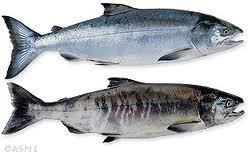
These fish will undergo a secondary sexual morph when they re-enter freshwater for the final stage of life. Often in the ocean, they pretty much look like silvery fish...individual species are identifiable, but they look very similar. But when they start to move upstream, they take on color changes and even the males will turn into montrous looking creatures. Below are pictures of some physical changes the pinks go through.

Female pink: not sure of the changes she goes through on the outside. Due to my minimal knowledge of salmon and fish in general, I think that this is what she will probably look like her whole life.

The males on the other hand, will at one point, look similar to the female above. But once they hit the freshwater they start to morph. They will often "darken" in color: taken on a pinkish hue and some watermarking. I hope to have examples of this later in the season with FRESH fish...these were all frozen. But I think the most marked change is that face. They will develop a kype, which is a pronounced curvature of the jaw. It, I suppose, is supposed to look "sexy" to the ladies. The teeth develop more and lengthen, although once the salmon hit freshwater they stop eating. The pink salmon males will also develop this huge hump on the back posterior to the dorsal fin. This one didn't really have one- I think he was taken early in the spawning season. Below is a picture of what they will eventually look like.


That was a really fun day with the kids. I love doing that stuff, not only working with children, but dissections are great! They can be gross (I did have to walk away at one point, after watching a kid gouge out the eyes with his bare hands), but such a great learning experience. I think I got just as much out of it as they did!


Thursday, June 14, 2012

The Funny River Weir Project

Since I arrived in Alaska almost 3 weeks ago, all I've been posting are pictures and stories of what I've been up to in my off time. I finally this week have begun to actually WORK! I had to sit through alot of orientation and policy talk, and training workshops. This past weekend I worked a festival here in the town of Soldotna that celebrated the mighty Kenai River. The Kenai is physically and economically the center of this peninsula. It provides revenue from tourists and fish as food for the local residents year round.

The movements and numbers of fish traveling the Kenai have been closely documented by the Fish and Wildlife Field Office biologists. The fish are such an important part of Alaska's economy, that big money is spent to learn about their habits so that practical laws and regulations can be put into action. It's called a "sustainable wild fishery".

There are multiple monitoring projects going on out of the office I work for, probably 2/3 of them are considered "remote". Only access is by float plane, or helicopter if water is too low to land on. The helicopter will literally drop a sling load on an exposed gravel bar, drop the staff off, and then they'll have to hike to their field camp and drive back with the boat.  I will be working on local projects, and to give you a taste of what that is, I'm going to explain what a weir is and how it works!

The Funny River, no idea where that name came from, is a tributary of the Kenai River. It's accessible to us, the Fish and Wildlife Service, by a private land owner. This man "homesteaded" his property...meaning back in the 50's when AK was becoming a state, he claimed his chunk of land and said it was his. It's a great cooperative project between a private citizen and a government agency.

This is what the Funny River weir looks like:


It's basically a PVC pipe fence that blocks fish from freely swimming upstream, while allowing water through. It angles at about 45* and is anchored upstream by sandbags. In the center, if you can make it out, is a tunnel that fish are channeled into. The big cage is a trap that is open at the time of this picture, but can be closed so that fish can be easily captured to take biological samples and measurements, and then released. And finally beyond that, which you can't see, at the base of the pole is the video box.

A closer look at the weir- daily I will be coming to this location and wading hip deep in the river to rake off the debris that gets caught up on the weir. This was taken on Wednesday the 13th, and today the 14th I couldn't see the PVC. We had about a day and a half of steady rain and the river rose a foot. It was pretty scary this morning wading out into that water!

The trap for fish. Above the chute is the door that slides down to close it.

Sideview of the trap. Upstream is to the left, and downstream is to the right.

Looking downstream at the weir.

This is the housing of the video equipment. In years past, and maybe even on some of the weirs that are in operation now, someone would have to sit on top of the trap and watch as fish passed below. They would have a thing in their lap that they'd tick on to keep track of species and sex of passing fish. This was done from above, in all weather, and whether or not fish were passing. The team has this ingenious system set up of a video surveillance system. It's like camera trapping on speed! The camera is a regular security camera that you could buy for your house, and it's motion sensored. There is a water proof housing and light system that it's all rigged up with to keep it safe and well lit. It records if something (fish, debris, beaver, etc) swim upstream under the weir, through the tunnel, through the trap, and through the video box. The fish have to go this route, all other paths are blocked to get up stream. THEN, in the software you can search by day and then by hour for a "blip" in the recording, and then you view it from the comfort of your office or whereever.


This is MY office for the summer :) It's a "weatherport", basically just a heavy plastic tent up on a platform. All the video recording equipment is housed here...and after I check the weir for any debris or faults, I sit in here and review the tapes. I'm able to fast forward, pause, and consult my Pacific Salmon ID cheat sheet :)

This is what the video software looks like...that gray area is a live view of the river. Nothing is swimming through at this moment, and the water is REALLY turbid due to recent rain events and warm of the glaciers (melt water). When we get some good footage I'll try to post some. It's really cool!

The species that are being observed are:


-Chinook (King) salmon
(Oncorhynchus tshawytscha)


-Chum (Dog) salmon
(Oncorhynchus keta)


-Pink (Humpy) salmon
(Oncorhynchus gorbuscha)


-Steelhead/Rainbow trout
(Oncorhynchus mykiss)

-Coho (Silver) salmon
(Oncorhynchus kisutch)


-Sockeye (Red) salmon
(Oncorhynchus nerka)

-Dolly Varden
(Salvelinus malma)


Incidentals could include:

-Northern pike (BAD!)
-Pacific lamprey
-Atlantic salmon (BAD!)
-Mink
-Beaver
-Otter

I'll be posting more about this all summer, as well as other projects I am involved with. Tomorrow I'm going to an elementary school and doing fish dissections with k-4 on pink salmon! It should be a good time.